Understanding Structural Dryout Challenges in Palm Bay Under Hardwood Flooring
Hardwood floors look beautiful in Palm Bay homes — until moisture gets underneath them.
Between summer storms, hurricane season, slab foundation moisture, and high humidity levels, water doesn’t need to flood your home to cause serious problems. It only takes minor intrusion or persistent humidity to seep beneath hardwood planks and into the subfloor.
Once that happens, structural dryout becomes far more complicated than most homeowners expect.
In Palm Bay and surrounding areas like Melbourne, Cocoa, Merritt Island, and Sanford, drying moisture trapped under hardwood flooring presents unique structural challenges. Let’s take a closer look at why this happens — and how proper dryout prevents long-term damage.
What Structural Dryout Really Means
Structural dryout is not just about removing visible water.
It involves restoring building materials — subflooring, framing, and structural supports — to safe moisture levels after water intrusion.
Under hardwood flooring, moisture can become trapped between:
- The hardwood planks
- The vapor barrier
- The subfloor
- The slab foundation
In Palm Bay’s humid climate, evaporation slows dramatically. That’s what makes structural drying under hardwood flooring especially challenging.
Why Hardwood Floors Are Vulnerable in Palm Bay
Palm Bay’s environmental conditions create persistent moisture pressure.
High Humidity
Indoor humidity often remains elevated, especially during summer.
Slab Foundations
Many homes sit directly on concrete slabs, which can retain ground moisture.
Heavy Rainfall
Stormwater intrusion through door thresholds and window seals is common.
AC Condensation
HVAC systems running long cycles may contribute to interior moisture imbalance.
Waterfront Proximity
Homes near canals or low-lying areas experience higher ground saturation.
Even minor water exposure can wick into hardwood planks and migrate downward into subfloor materials.
Early Signs Moisture Is Trapped Under Hardwood
Homeowners often notice subtle changes first.
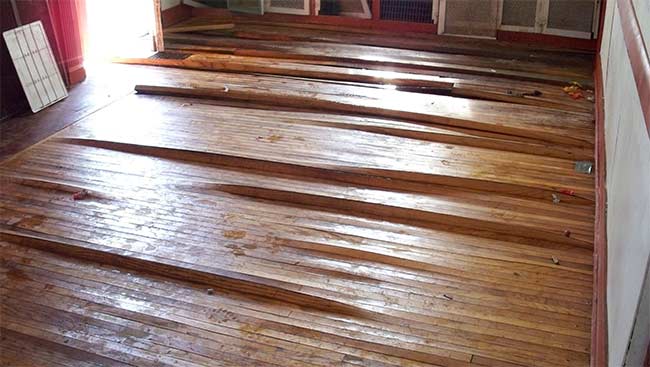
- Cupping or crowning of boards
- Gaps forming between planks
- Warped transitions
- Musty odors
- Discoloration along seams
- Soft spots underfoot
- Increased indoor humidity
In Palm Bay properties, these signs sometimes appear weeks after the initial moisture event.
That delay allows subfloor materials to remain damp — increasing structural risk.
Why Drying Under Hardwood Is So Difficult
Drying hardwood flooring requires precision. Improper drying can worsen damage.
Moisture Trapping
Hardwood creates a semi-sealed surface, preventing easy evaporation.
Vapor Barriers
Plastic or felt underlayment may trap moisture between layers.
Subfloor Saturation
Plywood or OSB absorbs water quickly and holds it.
Limited Airflow
Moisture under flooring lacks natural ventilation.
Florida Humidity
Even with fans, humid air slows the drying process.
Without professional-grade drying equipment and moisture monitoring, the subfloor can remain wet long after the surface appears dry.
Hidden Structural Risks
If moisture under hardwood flooring isn’t properly dried, it can lead to:
- Subfloor deterioration
- Mold growth between layers
- Framing damage
- Wood rot
- Fastener corrosion
- Permanent floor deformation
In coastal Palm Bay, salt air exposure can accelerate corrosion once materials are wet.
Ignoring the issue doesn’t make it disappear — it allows structural weakening to progress.
Why DIY Drying Usually Fails
Many homeowners try:
- Running household fans
- Opening windows
- Using small dehumidifiers
- Replacing individual boards
These approaches rarely reach moisture beneath the hardwood.
Surface drying does not remove moisture from:
- The underside of planks
- The subfloor
- The slab interface
- Wall base plates
Without targeted drying techniques, moisture remains trapped — creating ideal mold conditions.
Professional structural dryout focuses on restoring moisture balance at every layer.
Professional Inspection & Moisture Detection
Before drying begins, accurate assessment is critical.
In Palm Bay homes, proper inspection may include:
Moisture Meter Testing
Checking moisture levels in hardwood and subfloor layers.
Thermal Imaging
Identifying hidden damp zones without removing flooring prematurely.
Subfloor Evaluation
Determining if removal is necessary or if in-place drying is possible.
Humidity Monitoring
Tracking ambient moisture during the drying process.
Companies like Inspections and More FL use precise moisture detection methods to avoid unnecessary demolition while ensuring complete drying.
The Structural Dryout Process Under Hardwood
When properly handled, dryout under hardwood may involve:
Controlled Containment
Isolating affected areas to prevent humidity spread.
Specialized Floor Drying Mats
Creating suction-based airflow beneath planks.
Industrial Dehumidification
Lowering ambient moisture to accelerate evaporation.
Air Movement Control
Positioning air movers strategically without warping boards.
Subfloor Monitoring
Testing moisture levels regularly during drying.
Mold Prevention Measures
Applying anti-microbial treatments when appropriate.
The goal is to save flooring when possible — but never at the expense of structural integrity.
When Floor Removal Becomes Necessary
In some cases, removal is unavoidable.
If:
- Subfloor moisture exceeds safe thresholds
- Mold has developed between layers
- Planks have permanently warped
- Drying efforts fail
Selective removal may be required to protect the home’s structural components.
Early detection often prevents full-floor replacement.
Preventing Moisture Problems Under Hardwood
Palm Bay homeowners can reduce risk with proactive measures.
Inspect After Heavy Storms
Check for moisture near doors and windows.
Monitor Indoor Humidity
Keep levels between 45–55%.
Address Minor Leaks Immediately
Small intrusions become large problems under hardwood.
Service HVAC Systems Regularly
Ensure condensation drains properly.
Consider Vapor Barrier Evaluations
Especially in older homes.
Schedule Moisture Checks
Particularly in waterfront or low-lying neighborhoods.
Homes in Melbourne, Cocoa, Merritt Island, and Sanford face similar humidity pressure, but Palm Bay’s frequent storm activity increases exposure risk.
Why Local Experience Matters
Structural dryout in Florida is different from other regions.
Professionals familiar with Palm Bay understand:
- Slab moisture behavior
- Coastal humidity cycles
- Storm-related intrusion patterns
- Hardwood expansion in humid climates
- The balance between drying speed and material preservation
Inspections and More FL approaches hardwood dryout with a moisture-science mindset — prioritizing structural protection over cosmetic appearance.
That difference prevents recurring damage.
Acting Before Structural Damage Spreads
Hardwood flooring hides moisture well.
By the time visible warping appears, the subfloor may already be saturated.
Addressing moisture early:
- Reduces repair costs
- Preserves structural framing
- Prevents mold development
- Protects indoor air quality
- Extends floor lifespan
In Palm Bay’s climate, moisture control is ongoing. When hardwood flooring shows early warning signs, a professional structural dryout evaluation ensures the problem is corrected at its source — not just on the surface.
Proactive action always costs less than structural replacement.