
Understanding Air Scrubbing Challenges in Palm Bay During Extreme Humidity
Extreme humidity in Palm Bay changes how indoor air behaves. During long summer stretches, after tropical systems, or even during weeks of steady afternoon storms, moisture levels remain elevated both outside and inside homes. When mold remediation or contamination cleanup becomes necessary during these periods, air scrubbing plays an important role — but it also presents unique challenges.
Air scrubbers are powerful tools designed to filter airborne particles, including mold spores, dust, and microscopic contaminants. However, in Palm Bay’s humid climate, their effectiveness depends heavily on how moisture is managed at the same time.
Understanding the relationship between air scrubbing and humidity is critical for successful remediation.
What Air Scrubbing Actually Does
Air scrubbers use high-efficiency filtration systems to capture airborne particles. In mold remediation projects, they are typically used to:
- Reduce airborne mold spores
- Improve indoor air quality
- Support containment zones
- Protect unaffected areas
- Minimize cross-contamination
Air scrubbers are especially valuable during demolition, material removal, or when disturbing contaminated surfaces.
But here’s what many homeowners overlook: air scrubbers filter air — they do not remove moisture.
That distinction becomes crucial during extreme humidity.
Why Extreme Humidity Complicates Air Scrubbing
Palm Bay’s high humidity affects both air quality and building materials.
During extreme humidity:
- Air contains higher moisture content
- Mold growth accelerates
- Materials absorb moisture from the air
- Drying slows significantly
If air scrubbing is performed without controlling humidity, airborne particles may be reduced temporarily, but moisture conditions that allow mold to thrive remain unchanged.
Humidity fuels mold. Air scrubbers remove spores, not the conditions that create them.
The Interaction Between Humidity and Mold Spores
Mold spores are naturally present in most environments. In humid conditions, spores become more active and settle onto damp surfaces more easily.
In Palm Bay homes during humid periods:
- Walls may feel slightly damp
- Attic insulation may retain moisture
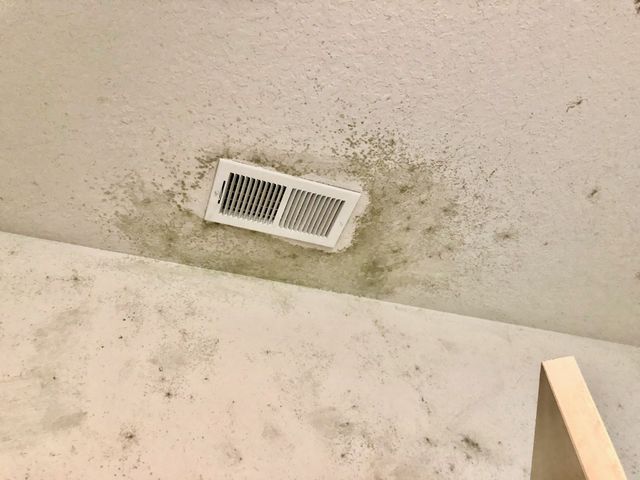
- Ductwork may sweat
- Subfloors may absorb ground humidity
Air scrubbing reduces airborne spore concentration. However, if surfaces remain damp, spores that settle can quickly begin growing again.
That is why air scrubbing must be paired with dehumidification.
Containment Challenges in High Humidity
During remediation, containment barriers isolate affected areas. Air scrubbers are placed within these zones to maintain negative air pressure and prevent spore migration.
In extreme humidity:
- Condensation can form on containment plastic
- Moisture may accumulate inside sealed zones
- Drying becomes slower within enclosed areas
If humidity inside containment rises too high, drying progress stalls.
Proper ventilation, airflow balance, and dehumidifier placement are essential to maintain stable conditions.
HVAC Systems Add Complexity
Palm Bay homes rely heavily on air conditioning to manage indoor comfort.
However, during extreme humidity:
- AC systems may struggle to dehumidify effectively
- Oversized systems may short cycle
- Duct leaks can introduce humid attic air
- Condensate drain issues may add moisture
If HVAC performance is compromised, air scrubbing becomes less effective because indoor humidity remains elevated.
Evaluating HVAC efficiency is often part of the solution when air scrubbing is needed.
Attic and Crawl Space Challenges
Air scrubbing in attics and crawl spaces during extreme humidity presents additional obstacles.
Attics
- High heat combined with humidity
- Sweating ductwork
- Limited ventilation
- Damp roof decking
Air scrubbers can filter air, but without drying equipment, attic moisture levels may remain high.
Crawl Spaces
- Ground moisture
- High water tables
- Limited airflow
- Lack of vapor barriers
Air scrubbing alone cannot address ground vapor intrusion.
Humidity control remains the priority.
Equipment Sizing and Placement
Air scrubber effectiveness depends on:
- Correct sizing for the space
- Proper filter maintenance
- Strategic placement within containment
- Balanced airflow patterns
In Palm Bay homes during humid weather, undersized equipment struggles to maintain clean air exchange rates.
Professionals calculate air changes per hour to ensure proper filtration.
Improper setup reduces efficiency and prolongs remediation timelines.
The Role of Dehumidification
Air scrubbing and dehumidification must operate together.
Dehumidifiers:
- Lower ambient humidity
- Accelerate drying
- Reduce condensation
- Create conditions unfavorable to mold growth
Air scrubbers:
- Capture airborne spores
- Improve air quality
- Support containment
When used together, they stabilize both air and surfaces.
Without dehumidification, air scrubbing becomes a partial solution.
Monitoring Indoor Conditions
During extreme humidity, continuous monitoring is critical.
Professionals measure:
- Relative humidity
- Temperature
- Material moisture content
- Airborne particle levels
Humidity should ideally remain below 60% to discourage mold growth.
Stopping air scrubbing too early — before humidity stabilizes — may allow airborne particles to rebound.
Why DIY Air Purifiers Are Not Enough
Homeowners sometimes attempt to manage mold concerns using small retail air purifiers.
These units:
- Lack industrial-grade filtration
- Cannot create negative air pressure
- Do not address humidity
- Are not designed for remediation environments
In Palm Bay’s humid climate, relying solely on consumer equipment rarely produces meaningful improvement during active mold remediation.
Professional systems are built for larger-scale filtration.
Prevention During Humid Seasons
Palm Bay homeowners can reduce the need for extensive air scrubbing by managing humidity proactively.
Helpful steps include:
- Servicing HVAC systems regularly
- Installing whole-home dehumidifiers
- Sealing ductwork
- Improving attic ventilation
- Installing crawl space vapor barriers
- Monitoring indoor humidity levels
Humidity control simplifies future remediation efforts if problems arise.
Why Local Experience Matters
Extreme humidity in Palm Bay behaves differently than in drier climates. Coastal air, seasonal storms, and high water tables all influence moisture patterns.
Understanding how local building styles respond to humidity improves air scrubbing effectiveness.
Inspections and More FL works throughout Palm Bay, Cocoa, Melbourne, Merritt Island, and Sanford, where humidity-driven remediation challenges are common. Experience with Florida’s environmental conditions ensures that air scrubbing is integrated properly with drying strategies.
Local knowledge reduces guesswork.
A Practical Final Perspective
Air scrubbing in Palm Bay during extreme humidity is valuable — but only when used correctly.
The practical sequence includes:
- Identifying moisture sources
- Correcting leaks or condensation issues
- Establishing containment
- Installing air scrubbers
- Running dehumidifiers simultaneously
- Monitoring humidity and air quality
- Verifying stabilization before equipment removal
Air scrubbers clean the air. Dehumidifiers control the environment. Together, they protect structures and indoor air quality.
In Florida’s humid climate, focusing on both air and moisture ensures lasting results — even during Palm Bay’s most humid months.
