Melbourne Homes Dealing With Moisture Detection During Storm Season — Cost Factors and Recovery Insights
Storm season in Melbourne isn’t just about wind and rain. It’s about what happens after the clouds clear. In Brevard County, especially in neighborhoods closer to the coast or near low-lying areas, moisture doesn’t always leave when the puddles dry.
Melbourne homes often deal with hidden dampness during storm season — moisture that slips into wall cavities, attic insulation, subfloors, and HVAC systems. That’s where professional moisture detection becomes critical.
Why Storm Season Moisture Is So Common in Melbourne
Melbourne sits in a coastal humidity zone. During storm season, several factors combine:
- Wind-driven rain entering small roof or window gaps
- Saturated soil increasing hydrostatic pressure
- High outdoor humidity slowing indoor evaporation
- AC systems running continuously
- Sudden temperature swings causing condensation
Even if a home doesn’t flood, storm-season moisture can migrate into structural materials quietly.
Unlike obvious water damage, hidden moisture spreads slowly and often remains unnoticed for days or weeks.
What Moisture Detection Actually Involves
Moisture detection is a structured evaluation process that identifies hidden dampness inside structural materials.
In Melbourne homes, this usually includes:
- Visual inspection of high-risk areas
- Moisture meter readings in drywall and flooring
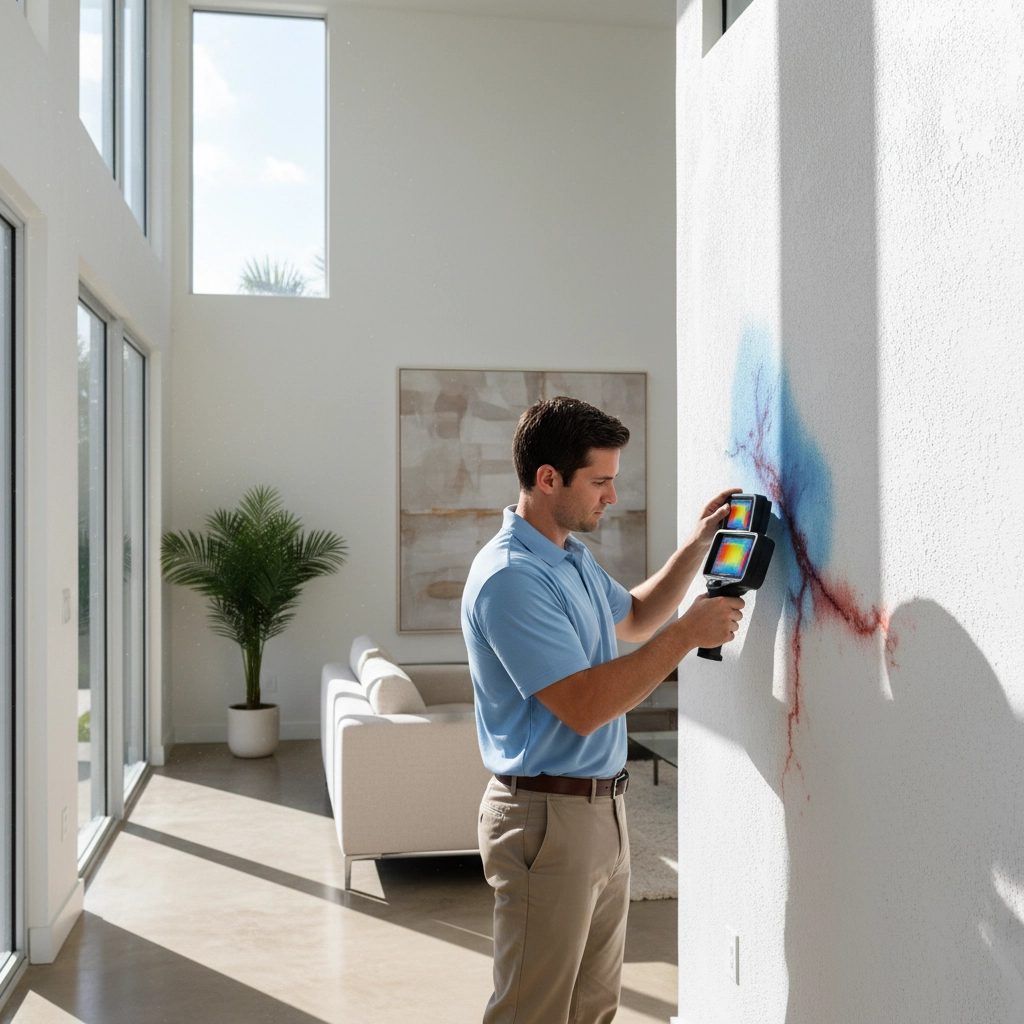
- Thermal imaging to locate hidden wet zones
- Attic and crawl space evaluation
- Humidity level measurement
The goal is not to tear things apart. It’s to pinpoint where moisture exists and determine whether drying is necessary.
Homes in nearby Palm Bay and Merritt Island face similar storm exposure, but Melbourne properties often deal with both coastal humidity and inland drainage issues depending on location.
Common Signs After Storm Events
Homeowners in Melbourne often report:
- Musty odor after heavy rain
- Ceiling staining
- Baseboards separating from walls
- Slight cupping in hardwood floors
- Windows fogging internally
- AC running longer than usual
Sometimes there are no visible signs at all. Elevated humidity alone can indicate hidden moisture inside structural components.
Storm-season moisture doesn’t always announce itself loudly.
Cost Factors in Moisture Detection
One of the most common questions homeowners ask is: “What affects the cost?”
Moisture detection costs vary based on several factors.
Size of the Home
Larger homes require more inspection time and more moisture readings.
Severity of the Storm Impact
If there was visible roof damage or significant rainfall exposure, additional scanning areas may be needed.
Accessibility
Attics with tight access points or homes with crawl spaces may require additional time and equipment.
Use of Advanced Tools
Thermal imaging and air quality sampling (when necessary) add to inspection depth and accuracy.
Number of Suspected Areas
If moisture is suspected in multiple rooms, subfloors, or walls, detection time increases.
The purpose of a structured inspection is to prevent unnecessary demolition or guesswork — which ultimately reduces larger repair costs.
Recovery Insights: What Happens After Moisture Is Found
Moisture detection doesn’t automatically mean major repairs. The next steps depend on findings.
If Moisture Levels Are Mild
In some Melbourne homes, minor elevated humidity can be corrected with:
- Targeted dehumidification
- Improved ventilation
- HVAC adjustments
If Structural Materials Are Saturated
More involved drying may include:
- Air blower installation along wall bases
- Industrial dehumidifiers
- Structural dryouts
- Removal of compromised insulation
If Mold Has Begun Developing
If moisture remained for extended periods, mold remediation may be required.
That process may include:
- Containment
- Removal of affected materials
- Cleaning structural framing
- Air scrubbing
- Mold encapsulation when appropriate
Professionals familiar with Brevard County conditions, such as Inspections and More FL, understand how Melbourne’s storm season influences moisture spread patterns.
Accurate detection ensures the recovery plan is proportional — not excessive.
Why Early Detection Reduces Costs
In Melbourne, the biggest cost factor isn’t usually the inspection. It’s the delay.
When moisture is left unchecked:
- Wood framing swells and weakens
- Subfloors begin deteriorating
- Insulation loses effectiveness
- Mold growth accelerates
- HVAC systems become contaminated
Early detection often limits recovery to drying and humidity control rather than extensive material removal.
Storm season moves quickly. So does moisture damage.
How Long Recovery Typically Takes
Recovery timelines depend on:
- Extent of moisture
- Weather conditions
- Indoor humidity levels
- Type of materials affected
Minor moisture issues may stabilize in a few days with proper equipment.
More severe structural drying may take several days of controlled airflow and dehumidification.
Melbourne’s humidity can slow natural drying, which is why professional equipment speeds up the process significantly.
Preventing Recurring Storm-Season Moisture
After detection and drying, prevention becomes the focus.
Melbourne homeowners can reduce future costs by:
- Inspecting roofs before and after storm season
- Ensuring gutters and drainage systems are clear
- Monitoring indoor humidity (ideal range 45–55%)
- Checking attic ventilation
- Sealing window and door gaps
- Servicing HVAC systems annually
- Scheduling routine moisture evaluations during peak storm months
Homes in Cocoa and Palm Bay follow similar patterns, but each location has slightly different soil drainage and elevation factors.
Proactive maintenance consistently lowers long-term repair expenses.
Why Local Experience Matters During Storm Season
Storm-related moisture behaves differently in coastal Florida than in dry climates.
Professionals familiar with Melbourne understand:
- Wind-driven rain intrusion patterns
- Slab moisture migration
- Lagoon and coastal humidity influence
- Storm surge risks in low-lying areas
- How quickly mold can begin developing in warm conditions
Experience allows faster identification of high-risk zones and more accurate recovery recommendations.
Without local knowledge, moisture patterns may be misinterpreted or underestimated.
A Practical Perspective for Melbourne Homeowners
Moisture detection during storm season is not about assuming the worst. It’s about confirming whether your home is truly dry after heavy weather.
Cost factors depend on home size, access, and severity — but early evaluation almost always reduces long-term expenses.
Recovery insights from local cases show a consistent pattern:
Homes that detect and dry moisture quickly experience less structural damage and lower overall repair costs.
In Melbourne’s storm season, moisture management is part of responsible homeownership.
With timely detection, controlled drying, and localized expertise, homes can recover efficiently — protecting structural stability and indoor comfort long after the storm passes.